Pages

5/25/2010

Don't Panic

It's Towel Day!  (Okay, not that I knew there was a Towel Day until this year, having finally read the books and all, but I will celebrate this year, dag nabbit.)

We have Douglas Adams and his Hitchhiker's Guide books for countless cultural memes and little existences that are so bizarre, hilarious and in some cases meaningful that they actually pre-date the Internet.  Can you imagine?  Among them:  42, Mostly Harmless, and of course, the words which are said to grace the cover of the Guide in soothing letters: "Don't Panic." 


I would really love to internalize that message (and also to get a Babel Fish, but I'd want to yank the fish out of my ear to hear French, because I just adore it).  That (the message and the fish) would be so convenient right about now.  As I have already said over the past weeks, I have had it about up to here *** (up there, at the top of the line) with my level of anxiety lately.  The problem with anxiety, whether you're talking anxiety attacks or generalized anxiety, is that when it's intense enough it actually saps your strength.  Your muscles get weak, first as a psychosomatic symptom, then as a physical reality because you've had them tensed up at either a huge intensity or for a long duration.  The energy the anxiety requires to maintain itself saps your reserves and you find yourself exhausted at the end of a day of doing nothing more than taking a thirty minute walk and doing some light HTML work (which we all know is physically and mentally taxing, woe).     

So let's all breathe deep and internalize the message:  Don't Panic.

And if that doesn't work, let's all find a Babel Fish.

5/19/2010

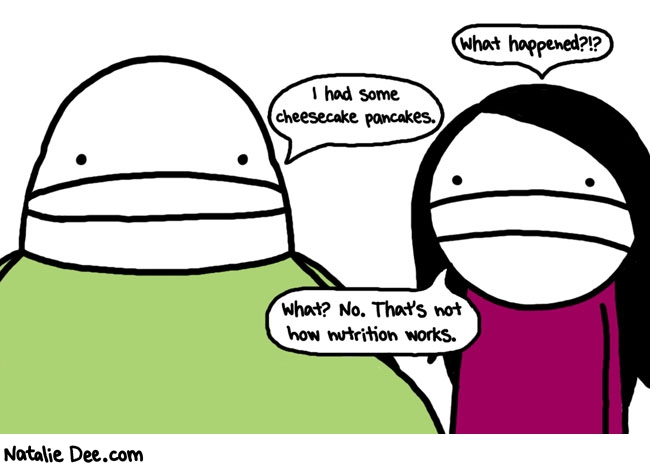
Postcard To Everyone Who Wants To Talk At Me About Food

From:  CN, via the inimitable Natalie Dee

To:  My husband, my in-laws, and all the other people who don't seem to understand nutrition, but who do seem to insist their ignorance of it be discussed ad infinitum as though it were canonical biological fact.


5/13/2010

Privacy or Secrecy

Bathers or The Secret
Henri Fantin-Latour

Privacy and secrecy in eating disorders can be hard to tease apart.  Where does my desire for privacy end and the destructive pattern of secrecy begin?  Part of what allows eating disorders to run rampant these days is the secrecy.   We the eating disordered engage in our symptoms in secrecy, whether the symptom of the moment/patient is exercise, restricting, purging, laxative abuse, etc.  You can restrict right out in public and still make a secret of it, because people don't want to know.  People don't want to talk about it; they don't want to know about it existing.  They'd rather chastise and "hate" thin women while simultaneously glorifying them, and judge and empathize with women who are perceived to be overweight or obese.  But people don't really want to think about anorexia, bulimia, or binge eating disorder as real things.  They're punch lines or train wrecks, but not surrounding you and sneaking up behind you in the form of your sisters, daughters, friends and co-workers.

The catch-22, of course, is that eating disorders aren't going to dwindle until there is a more thorough understanding of not only their causes, but of what sustains them at a social level.  But to have that discussion and reach that understanding, you've got to tell the truth and shame the devil, not just once and not just with one person or one patient, but over and over again, collectively.  That's why this blog exists, but, let's face it, a meagre 100 readers a day (a good chunk of whom are just here in a quest for the perfect bikini line) will not a social revolution foment.  I find myself ready to make the leap and leave certain privacies behind - for not only my good but the good of common knowledge - only on occasion.  This Sunday, I just couldn't do it.  I have to see that woman more often than I've been seeing her lately, and my psychological issues are... well, psych is tricky, isn't it?  People are open about diabetes or heart disease, but you're not going to have people discussing their bipolar meds or their DBT for borderline personality disorder in the same conversation as they're discussing some of the amazing new blood sugar testing technology.

Our psyches are our own, but our bodies are casually considered public property.  How do you reconcile that when you want to change this part of the Western world?

5/11/2010

Society Is Funny Except Not

I want to feel at home in my natural body, I really do, but I don't know how to get there.  No matter how far away from purging or restricting I've ever gotten - in mindset or on a calendar - it has never gotten easy to be in my body at the weight and shape it wants me to be.  The only guarantee so far has been that the farther away I get from a certain weight and shape, the more uncomfortable I am.  I've gone a good, long time - five and a half years - above that weight and beyond that shape, and I'm sorry to report that it never felt natural.  As naturally as I let my body behave, it never felt natural.  Not that this weight and shape that claims to keep me sane feels "natural" either.  Or "comfortable," necessarily.  But it's a different state of discomfort and disconnect.

And so much else supports this latter discomfort and disconnect.  On the one hand I have a doctor and family (incidentally, I'm seeing my mom this weekend, so that should be interesting) and friends and, you know, science pulling for the higher weight, the natural shape.  On the other hand, I have society in general and conversations like this:

Person I haven't seen in a while:  CN, you're so skinny --
Me:  Yeah --
PIHSIAW:  You look beautiful!!

I think my face did one of these:


"wtf?"

And then I literally walked away without replying.  It was one of my more socially inept moments, but I had just no idea what to say.  It was probably better, because if I'd said anything, it would have been what very nearly made it out, which was, "I have an eating disorder and am medically classified as underweight."  All things considered, it was probably better that I wandered off like a four-year-old.

5/02/2010

The Accomplished Body


The Met features chamber music on their main balcony on Friday nights, and I availed myself of the wonderful opportunity this Friday.  I was seated at a table adjacent to the musicians with the cellist in my direct view.  It didn't take me long to notice that her body actually reminded me of her cello in its solidity.  I found myself imagining thinking about the physical demands of playing some instruments (from keeping the appropriate posture for hours, so the arm muscles involved in some types of playing).  I also found myself thinking about the calibre of New York musicians; in America they are some of the best, and if you're a quartet playing at the Met, you're at the level of a symphony player in a smaller city, at the very least.  The cellist (her colleagues too) uses her body (in part) to achieve and hold onto this great accomplishment in the music world.  

Because I am basically an ego-centric creature, I then found myself wondering if I would employ eating disordered behaviors if I were an accomplished musician, or an accomplished archeologist, or an accomplished any profession (other than dancer/athlete) that requires certain bodily capabilities.  It might seem like an insensitive question - there are, after all, successful people with eating disorders in all professions - but I really wonder if my body was linked indirectly to my sense of professional accomplishment, whether I'd feel as much of a need to manipulate it.  My guess: probably not.

The next logical thing to think is, "Okay, so how do you match that sense of accomplishment?  What kind of accomplishment do you think you're missing that's preventing you from treating your body naturally?"  This is the part where I draw a blank.  The husband and I started and continue to run a successful business.  The service we provide is somewhat of an intangible commodity, but the fact that we started and are operating a thriving company is... I mean, that should be *something*, right?  But there are no bodily requisites for the business we run (other than being able to stare at a computer screen for twelve hours at a time).  

The next mental step I take here is to think, "Okay, but does it have to be a professional accomplishment or state of being?  What about a personal one?"  I have friends who are mothers, whose bodies are totally changed from what they were in high school, and who love their new bodies, because those bodies gave them their children (or, at our age, mostly "child" singular).  Do I think that if I were to accidentally become a mother-to-be sometime soon that my attitude toward my body would radically change?  Hahahaha, OMQF, bwaaaaahahahahaha, yeah right.  (Optimistically, there's always a chance that unexpected motherhood would be all I needed, but let's be realistic, shall we?  Now is not the time to procreate for me.)  So what about becoming accomplished at yoga or aikido?  I know right now that physical activities wind up with me back in my head, planning how much weight I can lose or how specifically I can sculpt a part of my body, which is why I don't exercise when I'm like this.  For some people it's a huge help to symptom management and reduction; for me it's always had the opposite effect.

I don't have any answers right now (or I'd be better).  And I don't really have a tidy way to end this post, so I may as well wrap up here.  Just some things I've been thinking about.